
1. Introduction: The Tension Between Decoding, Dissection, and Delight
In contemporary K-12 education across India, the pressure to demonstrate measurable academic growth has driven a profound shift toward diagnostic, highly granular literacy models. Frameworks built around technical Reading Cognition and Analysis (RCA) break language down into explicit sub-skills, isolated vocabulary banks, tiered syntax rules, and multi-layered comprehension rubrics.
The core premise of these models is logical: by diagnosing the exact micro-tier where meaning breaks downwhether in domain-specific vocabulary, complex clause structures, or inferential reasoningeducators can intervene with targeted precision.
The Central Risk: Mistaking the diagnostic engine of reading for the journey itself. While structured frameworks offer acute utility for remedial intervention, they must never extinguish the organic joy of immersion.
While structured frameworks offer diagnostic utility for remedial intervention, they often fail to cultivate true, lifelong literacyespecially in multilingual environments. Reading in its organic, unstructured formoften termed "just reading," reading for pleasure, or natural immersionis fundamentally superior for long-term cognitive, emotional, and intellectual development. Natural reading approaches text not as a clinical puzzle to be solved or a dataset to be dissected, but as a dynamic ecosystem of ideas, imagination, and human experience. When reading is allowed to happen naturally, it engages the mind in ways that technical frameworks, no matter how sophisticated, cannot replicate.
2. The Multilingual Mind: Navigating L1 Thought and L2 Friction
The Indian educational landscape presents a unique neuro-cognitive baseline: the vast majority of students are raised naturally bilingual or trilingual, navigating a home language (mother tongue/L1), a regional lingua franca (L2), and English (L3) simultaneously. This multi-tongued cognitive architecture fundamentally alters how the brain processes text, syntax, and meaning.
Syntactic Inversion: Subject-Object-Verb (SOV) vs. Subject-Verb-Object (SVO)
When a multilingual child reads or writes in English, they naturally think in their mother tongue (L1) and translate into English (L2). This introduces a profound structural mismatch between Indian languages and English sentence architecture:
- Indian Languages (L1 Structure): Subject + Object + Verb (SOV)
- English Language (L2 Structure): Subject + Verb + Object (SVO)
The Multilingual Translation Loop
How L1 thought patterns map into English and risk mental exhaustion under purely mechanical dissection:
When an Indian student thinks in L1 and performs a direct mental translation, their left brain attempts to force an SOV thought pattern into an SVO template. Over-analyzing these translation errors using purely mechanical diagnostic drills compounds the problem, forcing the student into an exhausting tri-fold translation loop.
3. Left-Brain Mechanics vs. Right-Brain Metacognition
Metacognitionthe ability to think about one's own thinkingoperates across both brain hemispheres, each offering distinct contributions to reading and comprehension:
- Left-Brain Metacognition (Logical, Sequential, Diagnostic): Focuses on explicit syntax parsing, phonological decoding, rule-based grammar structures, and isolated vocabulary categorization. It asks: "What is the grammatical construction of this sentence, and which tier-word is being used?"
- Right-Brain Metacognition (Global, Visual, Emotional, Conceptual): Focuses on narrative arc, emotional tone, contextual synthesis, metaphor, and conceptual visualization. It asks: "What does this scene feel like, and how does this idea connect to my lived reality?"
| Dimension | Left-Brain Analytical Frameworks (RCA) | Right-Brain Organic Immersion ("Just Reading") |
|---|---|---|
| Primary Processing Style | Linear, analytical, rule-driven | Global, intuitive, visual, and conceptual |
| Focus Area | Clause structure, tier vocabulary, mechanics | Theme, narrative flow, emotion, and context |
| Multilingual Role | Inter-language syntax comparison & translation | Cross-linguistic concept mapping & intuition |
| Cognitive Friction | High (Tri-fold translation loop) | Low (Direct mapping onto L1 conceptual matrix) |
| Affective Outcome | Performance anxiety and task fatigue | Deep psychological flow, pleasure, and curiosity |
Suppressing Intuitive Code-Switching and "Sprachegefhl"
Indian speakers naturally use code-switching and transliteration as sophisticated cognitive tools. Right-brain metacognition leverages this fluid linguistic agility to grasp complex, abstract ideas instantly. A trilingual student who already understands concepts like justice, grief, or causation in their mother tongue does not need to relearn these concepts in English; they only need natural exposure to English sentence flow.
Organic reading builds Sprachegefhlan intuitive, right-brain "feel" for sentence cadence and rhythm. By flooding the mind with authentic SVO sentence patterns through volume reading, the brain implicitly overwrites incorrect structural translations without needing tedious parsing or punitive error-correction sheets.
4. Intrinsic Motivation and the Psychology of "Flow"
The most significant vulnerability of rigid reading analysis frameworks is their reliance on extrinsic structure. When a child approaches a text knowing they will be systematically evaluated on specific sentence structures, vocabulary tiers, or standardized comprehension questions, the nature of the activity shifts. Reading ceases to be an act of personal exploration; it becomes a series of compliance checks.
Autonomy & Agency
Long-term engagement requires autonomy, competence, and relatedness. Allowing learners to choose books aligned with their personal interests and cultural backgrounds triggers exponential cognitive investment.
The Psychology of Flow
Immersive reading requires effortless psychological absorption where self-consciousness fades. Constantly pausing for clause identification breaks reading rhythm, replacing flow with cognitive friction.
The Readers Volume Paradox
Reading volumethe sheer number of words processedis the single strongest predictor of academic success. Intrinsic joy drives voluntary reading of millions of words annually outside the classroom.
5. The Affective Domain: Empathy, Imagination, and Self-Discovery
To reduce reading to a purely cognitive or diagnostic skill is to strip it of its humanity. Literature is not merely a vehicle for transmitting information or testing grammar; it is an art form designed to explore moral complexity, evoke emotion, and foster empathy.
Theory of Mind
Inhabiting character perspectives builds social intelligence, empathy, and affective depth that cold grammatical parsing completely bypasses.
Unconstrained Imagination
Unlike pre-rendered visual media, text demands active sensory co-creation, training adult capacity for innovation and novel problem solving.
Reflective & Therapeutic
Reading provides a sanctuary for internal dialogue, emotional regulation, and ethical maturation across adolescence.
6. Conclusion: Rebalancing Literacy Philosophy
The argument for organic reading is not a total rejection of diagnostic tools or structured instruction. For early learners or students with specific learning differences, targeted support in phonics, decoding, and syntax structure plays an important diagnostic role.
Technical Frameworks as the Foundation, Not the Destination
Systemic reading analysis frameworks provide the maintenance infrastructure, but organic reading provides the ultimate purpose. In multilingual classrooms, better reading outcomes, broader vocabularies, and deeper critical minds do not emerge from an endless cycle of dissecting texts under a diagnostic microscope. They emerge when students are inspired to fall in love with reading, granted the autonomy to explore rich books, and are allowed to experience the transformative power of language in its fullest, unfragmented form.
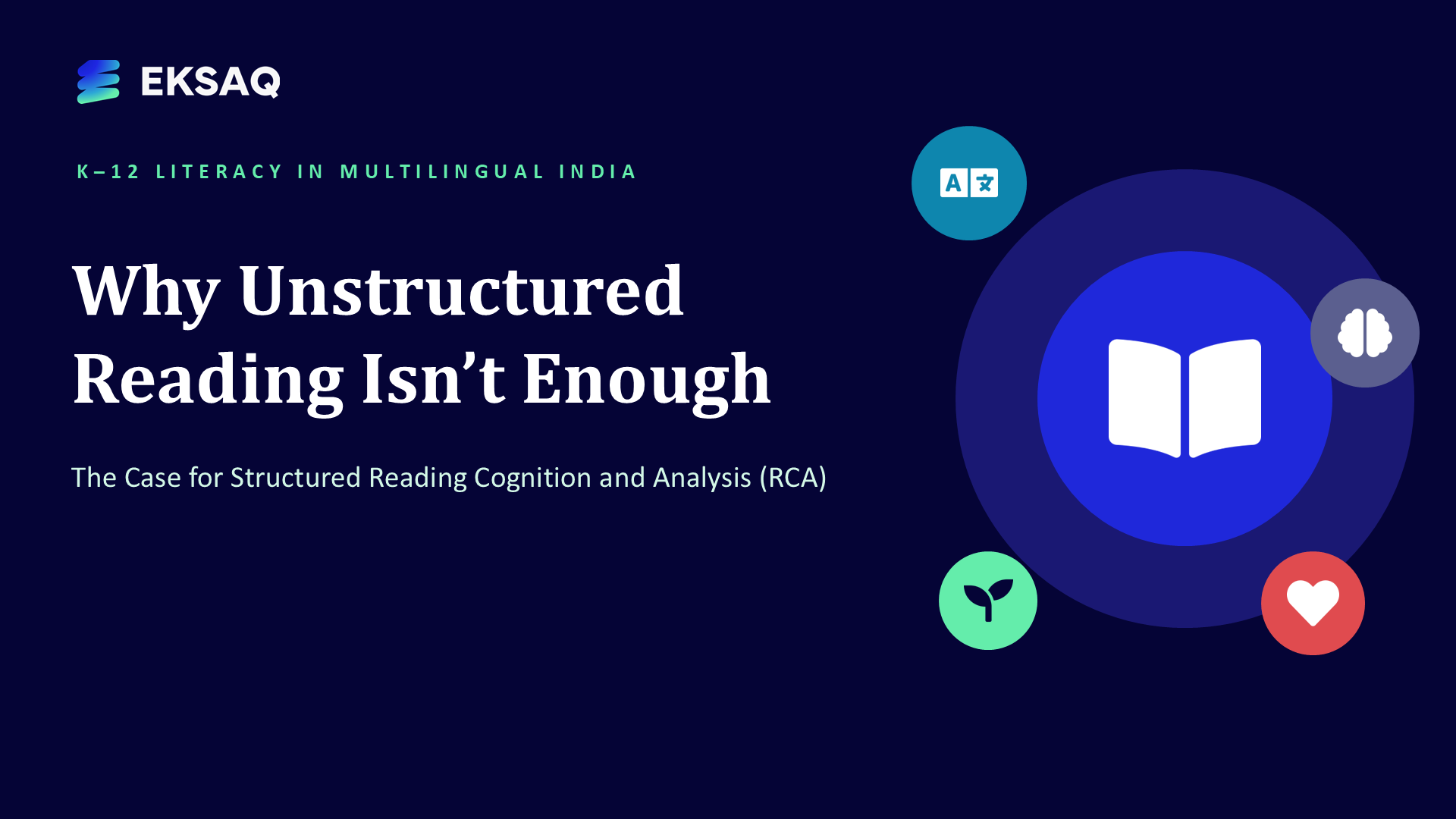
Why Unstructured Reading Isn't Enough (RCA Executive Deck)
About This Video Briefing
This executive briefing investigates the cognitive nuances of reading comprehension in multilingual India. Exploring the friction between L1 thought translation and L2 English syntactic structures, the video outlines how structured Reading Cognition and Analysis (RCA) empowers educators to target comprehension bottlenecks while preserving the emotional delight of reading.